File:P1. Bhar et al. 2023. Manuscript IKS Studies (16.10.23) page-0001.jpg

Original file (1,241 × 1,754 pixels, file size: 938 KB, MIME type: image/jpeg)
Summary
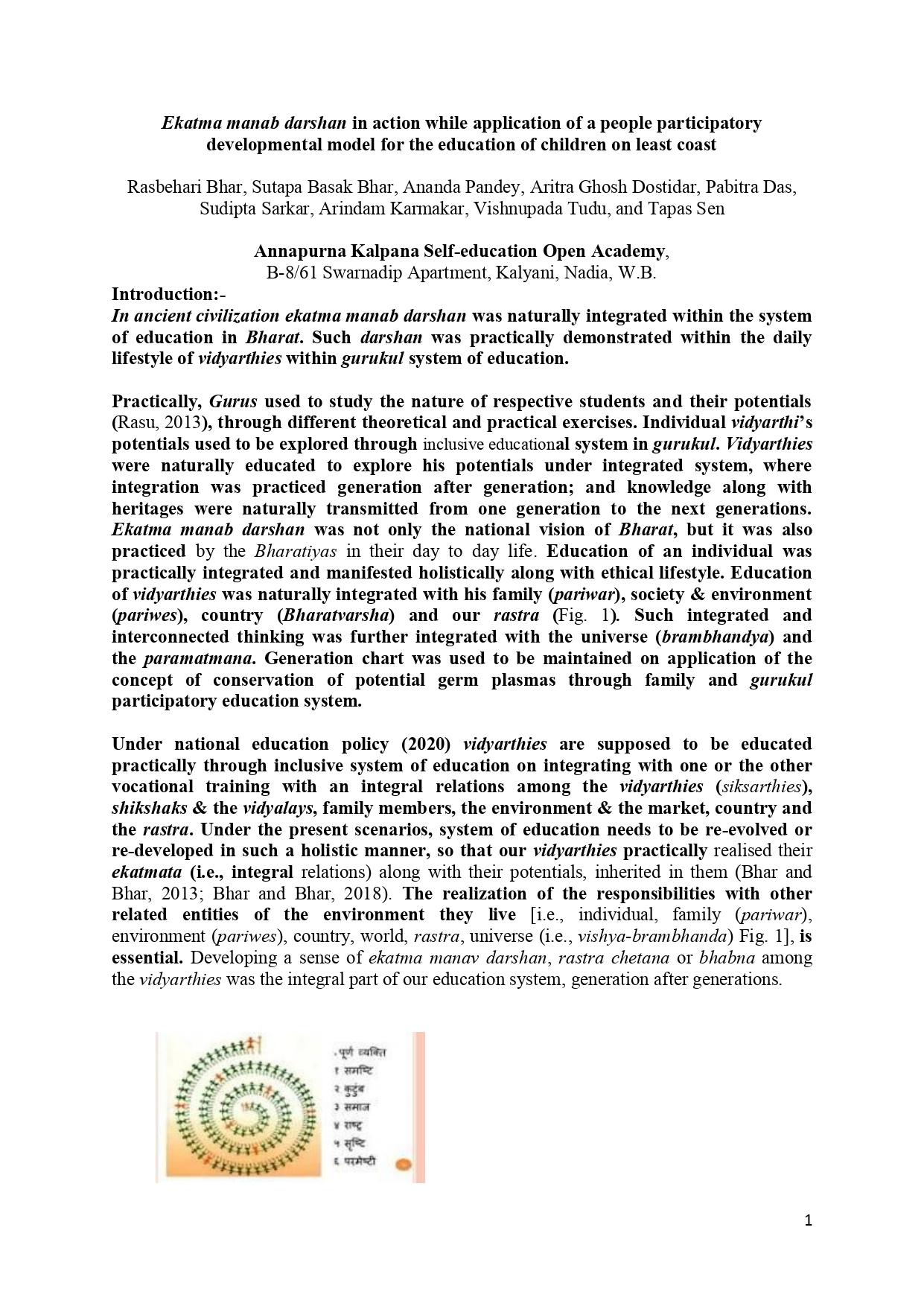
Ekatma manab darshan in action while application of a people participatory developmental model for the education of children on least coast
Rasbehari Bhar, Sutapa Basak Bhar, Ananda Pandey, Aritra Ghosh Dostidar, Pabitra Das,
Sudipta Sarkar, Arindam Karmakar, Vishnupada Tudu, and Tapas Sen
Annapurna Kalpana Self-education Open Academy,
B-8/61 Swarnadip Apartment, Kalyani, Nadia, W.B.
Education is the manifestation of the perfection in an individual. Exploring perfection in vidyarthies is one of our local & national priorities. Perfection would automatically goes on reflecting in the basic character of the individual, while the process of education would go on progressing. Educating, on inculcating some basic qualitative traits in vidyarthies, is supposed to improve their personality on reflecting their quantitative traits, also. Several references are available in our ancient literature (i.e., Repository of IKS) on basic principles and system of Bharatiya educations. Thus, to implement national education policy, we are supposed to integrate IKS to develop an area specific inclusive education (i.e., environment friendly) in different communities of students.
Thus, a people participatory technical programme was proposed to be prepared for personality development of some children and school students; on promoting national education policy among different communities of students. The technical programme of the project proposal would facilitate the implementation of National Education policy; while integrating the existing system of education among different communities of students. A baseline data on successive improvement of some basic traits and characters (#), related to the personality development of students would be generated on demonstration of basic principles of education.
#("काक चेष्टा, बको ध्यानं, स्वान निद्रा तथैव च ।
अल्पहारी, गृहत्यागी, विद्यार्थी पंच लक्षणं ॥")
On conducting people participatory survey and brain storming meeting (Fig. 2), it has been revealed that even if, our children are admitted in schools, and they are keeping private tutors in different subjects, even during the age of pre-schools (i.e, Pre-nursery, Nursery and KG). Further, the parents of the primary school students of poor families are spending significant amount of money (Say Rs. 250 to 600/- per students per month). Furthermore, parents of the students of higher secondary school are spending much higher private tuition fees (Rs. 600/- to 2000/-) in different families including tribal. Moreover, numbers of students in many Govt. Primary schools are decreasing significantly. Parents are interested to admit their children even in private English medium school, rather than government school.
Even if, significant amount of expenditure is made by the parents and the concern Government, performances of several students are not satisfactory, neither their sense of responsibility (chetana) are growing in reference to the system of schooling presently going on in most of the school. Neither the marks, obtained by students in particular subject, are satisfactory; nor are the qualitative traits of several students satisfactory.
Further, the family size has also been decreased significantly; parents are not getting adequate times for their parenting, to supervise their children. Furthermore, many parents of poor families, particularly in tribal, SC, OBC families, are illiterate. They are unable to supervise the studies of their children.
In families of medium to higher income groups, the parents, even if qualified, are also not getting adequate time for their parenting due to their nuclear family sizes. Parents are giving time for optimizing the earnings of their families. Thus, the current study has been initiated to address the performance & personality development of vidyarthis in respect to their qualitative (i.e., marks) and quantitative traits (i.e., nutritional status, personality & physical ability), to demonstrate an inclusive education system, on application of ektma manab darshan along with a developmental model (Negi et al., 2015a,b; Bhar and Bhar, 2002, 2015, 2018; Bhar et al., 2017, 2018, 2019a,b,c; Bhar, 2013, 2020; Singh and Singh, 2017).
Materials & Methods:
1) At first for people's participation in the project, several group discussions were arranged at different villages (Fig. 2)
2) On inviting teachers of different schools, the technical programme was presented on conducting four to five brainstorming people participatory interactive seminar on the topic, "Importance of personality development programme among the school students" and the ektma manab darshan (Fig.1, 2).
3) The survey was conducted in some villages (viz, Antpur, Ranibazar, Palpara, Kumar Bazar and Tara) for selection of voluntary teachers and sechhasewaks to facilitate implementation of the technical programme in different villages;
4) Thereafter, man and materials needed for initiating open academics were arranged on conducting people participatory survey. Unutilized and underutilized land, buildings, qualified human resources were arranged on free of cost or least cost. For arranging the assets on free of cost, (i.e., without any extra budget of Annapurna Kalpana Self-education Open Aacademy), or least cost; a developmental model and the concept, “Rassi (rope), Roshni (light), Rakshabandhan (conservation, protection, prevention)” was applied (Bhar et al., 2018, Bhar & Bhar, 2018; Bhar, 2020) for peoples participation. Assets holders were motivated to participate as sechhasewaks for implementation of the technical programme of the project, “Studies on Inculcating the Five Basic Traits in Vidyarthies in Improving Their Personality in Reference to the IKS & NEP 2020”;
5) Sechhasewaks were trained and made skilled full to devote their time in supplementary parenting to take care of the children and students, particularly during the hours of open academics of AKSOA (Annapurna Kalpana Self-education Open Academy);
6) School students of different classes and schools were got admitted to participate in the supplementary course of the personality development programmes of AKSOA;
7) Open academics cum personality development programmes were initiated one by one in four villages, namely, village Tara, Ranibazar, Palgacha and Kumorpara (Fig.4). Demonstration (in early morning for one and half hours daily) of play methods of education & personality development programme were arranged in underutilized fields and play grounds
8) Parents participatory technical programmes were implemented for awaking up of the children and school students early in the morning at 4.30am at Ranibazar village. Likewise three other open academics were opened by the AKSOA.
9) Voluntary teachers (five in numbers), field supervisors cum monitors were engaged and trained to record basic data on overall personality development of students in four open academics of AKSOA.
10) Perceptions of individual teachers on successive personality development of students were recorded. In the current article overall perceptions of four teachers are presented as Mean ± SE (Table 1). Teachers were requested to note their perceptions (i.e., LP; level of perception) on different parameters of personality, on joining of students; and thereafter, at monthly interval (viz., overall personality, efforts, concentration, sleeping skills, eating skills, physical efficiency, reading skills, writing skills etc) (Fig. 3). Markings were made by individual teachers in a scale of 1 to 10.
11) To record the data on personality development, following classes were arranged daily:-
A. Free hand exercise, different asanas, playing different indigenous games in first class (60minutes);
B. Chanting different Sanskrit slokas on education of children and group discussion (30minutes) cum memory games, storytelling etc.
Students (among the girls and boys students), having relatively higher personality, were assigned with the additional responsibility of functioning as monitors.
Generation of facilities, man, materials and the data on people participation, on least cost or no cost: Through people participatory technical programme, numbers (15 in numbers) of sechhasewaks or volunteers were found out from the different villages, viz., Antpur, Ranibazar, Kumar Bazar, Palgacha of the block, Jangipara, District, Hooghly, West Bengal. It seems that a social impact was created through the motivational interactive seminars on the concept of personality development of the children and school students, inclusive education, ekatma manab darshan. On further demonstration of play methods of education & personality development programme, participation of children, school students, sechhasewaks were gradually increased from 10 to 120. Ekatma manab darshan was felt by the villagers through the sewa project of AKSOA. As result of which a building, having about 12 rooms, was given to the AKSOA without any rent. Shri Pabitra Das, one of the sechhasewaks of AKSOA sponsored the building for the functioning of the project. Further, one room was purchased by (Smt. Sutapa Bhar) one of the team members of the researchers to establish the office of the project. Till September, 2023, altogether 115 students enrolled in the project. Number of vidyarthies at respective open academics are as follows: Ranibazar - 54, Palgacha - 12, Tara - 20 and Kumor Bazar – 29.
Conclusion:
It seems that the social works and the sewa project, “Studies on Inculcating the Five Basic Traits in Vidyarthies in improving their personality in reference to the IKS & NEP 2020”; being carried out has created an impact in the villages, surrounding Antpur, district- Hooghly, West Bengal. For better presentation of our data one negative control group would be created in further studies. In the current studies of about one and half months, overall 31.48% improvement was noticed in the development of the personality among the students (115 in numbers). Further, ekatmata and ekatma manav darshan was felt among the participated families of different villages. Demonstration of the concepts of open academics has created an impact in the local population, on least cost; on application of the people participatory developmental model and the concept, “Rassi (rope), Roshni (light), Rakshabandhan (conservation, protection, prevention)”.
File history
Click on a date/time to view the file as it appeared at that time.
| Date/Time | Thumbnail | Dimensions | User | Comment | |
|---|---|---|---|---|---|
| current | 12:03, 1 November 2023 | | 1,241 × 1,754 (938 KB) | Rasbehari (talk | contribs) | Generation of facilities, man, materials and the data on people participation, on least cost or no cost: Through people participatory technical programme, numbers (15 in numbers) of sechhasewaks or volunteers were found out from the different villages, viz., Antpur, Ranibazar, Kumar Bazar, Palgacha of the block, Jangipara, District, Hooghly, West Bengal. It seems that a social impact was created through the motivational interactive seminars on the concept of personality development of the ch... |
You cannot overwrite this file.
File usage
There are no pages that use this file.
_page-0001.jpg&oldid=162)